
Home Articles Money & fine print
Money & fine print
The safest ways to pay: which payments you can get back
How you pay decides what you can do when a seller disappears. Choose the method before you choose the seller.
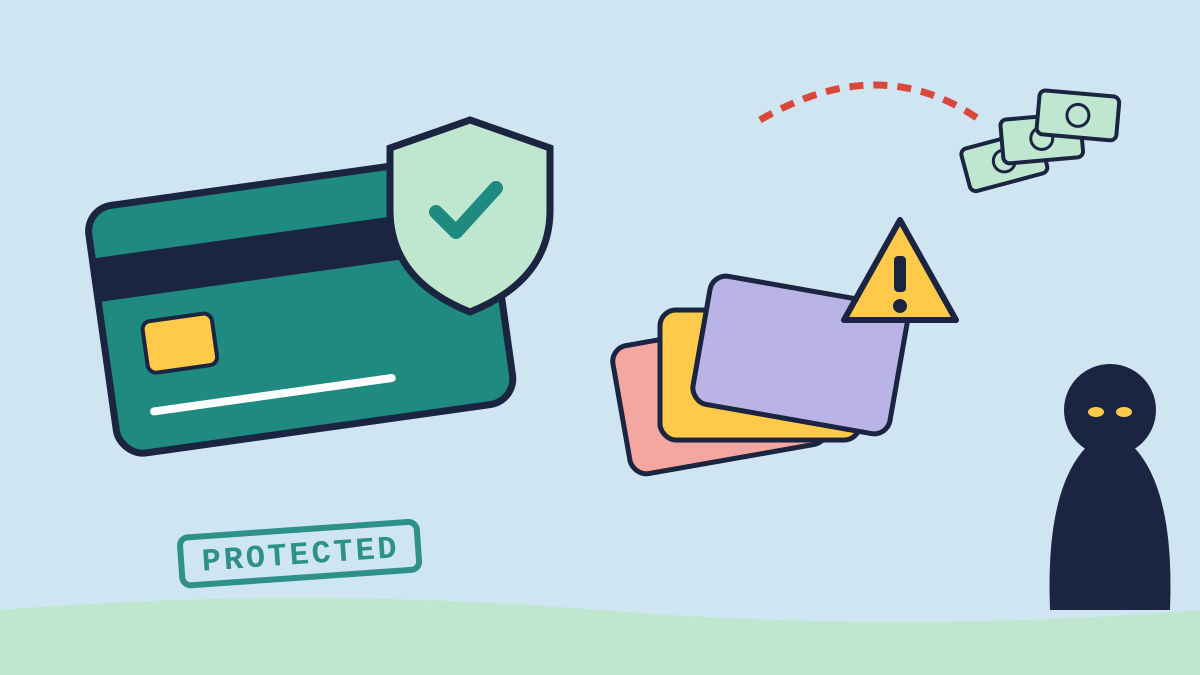
When a purchase goes wrong — the goods never arrive, they are not what was described, or the seller turns out to be a fraudster — your chances of getting your money back depend heavily on how you paid. Some methods come with legal protections or dispute processes. Others work like handing over cash: once it has gone, it has gone. This guide ranks the common options and explains why.
Credit cards: usually the strongest protection
In the United States, the Fair Credit Billing Act lets you dispute billing errors on credit cards, which include charges for goods or services you did not accept or that were not delivered as agreed. You generally need to send a written dispute to the card issuer within 60 days of the statement that first showed the charge. For unauthorised use of a credit card, federal law caps your liability at $50, and many issuers offer zero-liability policies.
In the UK, Section 75 of the Consumer Credit Act makes the credit card provider jointly liable with the seller for purchases of a single item costing more than £100 and up to £30,000, if something goes wrong. That means you can claim against the card provider as well as the seller, which is particularly powerful when a business goes bust.
Card networks also run chargeback schemes, which let issuers reverse transactions in certain circumstances. Chargebacks are card-network rules rather than law, so they have time limits and conditions, but they are often available for both credit and debit cards.
Debit cards: good, but less than credit
Debit cards take money straight from your bank account, so while a dispute is investigated, it is your money that is missing. In the US, the Electronic Fund Transfer Act limits liability for unauthorised debit card use, but the limit depends on how quickly you report it: report lost or stolen cards promptly, ideally within two business days, because the protection shrinks the longer you wait. For disputes about the goods themselves, debit cards rely mainly on chargeback rules. In the UK, debit cards are not covered by Section 75, but chargeback is still available through your bank.
Payment services and apps
Payment services vary widely. Some offer buyer protection for purchases made through their “goods and services” option, typically covering items not received or significantly not as described. Their “friends and family” option, by contrast, is meant for sending money to people you know and usually has no purchase protection. Sellers who ask you to choose the friends-and-family option “to avoid fees” are asking you to give up your protection.
Instant peer-to-peer apps and bank transfer services are designed for paying people you know and trust. In the US, if you authorise a payment to a scammer through one of these apps, getting it back is often difficult, because you approved the transfer. Treat them like cash when buying from strangers.
Bank transfers and wires
Wire transfers are very hard to reverse. If you realise you have wired money to a scammer, contact your bank immediately and ask it to try to recall the transfer; speed matters, but recovery is not guaranteed.
The UK is an exception worth knowing about. Since October 2024, most victims of authorised push payment (APP) scams — where you are tricked into sending a bank transfer via Faster Payments or CHAPS — must be reimbursed by their payment provider, up to a set maximum per claim, subject to some exceptions such as gross negligence and time limits for reporting. Report to your bank as soon as you realise.
Gift cards, cryptocurrency and cash by post
These are the payment methods scammers prefer, because they are fast, hard to trace and almost impossible to reverse. The US Federal Trade Commission says plainly that anyone who demands payment by gift card is a scammer. No legitimate government agency, utility, landlord or business will insist on gift cards or cryptocurrency as the only way to pay. If you are asked to, stop.
| Payment method | Protection if things go wrong | Best used for |
|---|---|---|
| Credit card | Strong: billing-error disputes (US), Section 75 (UK), chargeback | Online shops, deposits, larger purchases |
| Debit card | Moderate: chargeback; your money is out while disputed | Everyday purchases from known retailers |
| Payment service “goods and services” | Moderate: provider’s buyer protection, with conditions | Marketplace purchases that are posted |
| Payment app “friends and family” / P2P apps | Weak: usually none for authorised payments | People you know |
| Bank transfer / wire | Weak in the US; UK APP reimbursement for scams | Trusted, verified payees |
| Cash | None, but you pay only when you have the item | In-person collection after inspection |
| Gift cards, crypto | Effectively none | Never as payment to a stranger |
Habits that protect any payment
- Pay the business, not an individual: the payee name should match the company.
- Verify bank details by phone using a number you found independently, especially if an invoice says the details have “changed”.
- Keep screenshots of listings, prices and messages until the purchase is complete.
- Stage large payments against progress, as in our contractor guide.
- Check statements promptly; dispute windows start running from statement dates.
- Never let urgency push you into a less protected method.
If it has already gone wrong
Contact your card issuer, bank or payment provider straight away, explain what happened, and ask what dispute or reimbursement options apply. Put it in writing and keep copies. Then report the fraud: in the US to the FTC at ReportFraud.ftc.gov (and the FBI’s IC3 for online fraud), in the UK to Report Fraud (Action Fraud). Be wary of anyone who contacts you offering to recover lost money for a fee; recovery scams target people who have already been scammed.
Frequently asked questions
Is a credit card really safer than a debit card for online shopping?
Generally yes. Credit cards come with stronger legal dispute rights in the US and Section 75 in the UK, and the disputed money is the lender's, not yours, while it is investigated.
Why do sellers ask for 'friends and family' payments?
It avoids fees for them, but it usually removes your buyer protection. For purchases from people you don't know, use the goods and services option or another protected method.
Can I get money back from a gift card I sent to a scammer?
Sometimes, if you act very quickly: contact the gift card company immediately with the card number and receipt. Often the funds have already been spent, which is why scammers prefer gift cards.
Does Section 75 cover the whole purchase if I paid only a deposit by card?
It can. If the item costs more than £100 and up to £30,000, paying even part of it on a credit card can bring the whole purchase within Section 75. Check the details with your card provider.
Related articles
Shops & sellers
Is this online store legit? A step-by-step check
How to tell whether an unfamiliar online shop is real: web address, domain age, contact details, reviews off-site, return policies, payment options and scam patterns. Open the case file →
Shops & sellers
How to buy second-hand safely from private sellers
How to research private sellers on marketplaces, check items for theft and recalls, avoid overpayment and verification-code scams, meet safely and pay with protection. Open the case file →
Hiring & renting