Shops & sellers
Is this online store legit? A step-by-step check
Fake shops can look better than real ones. Instead of judging the design, test the things a scammer finds hard to fake.
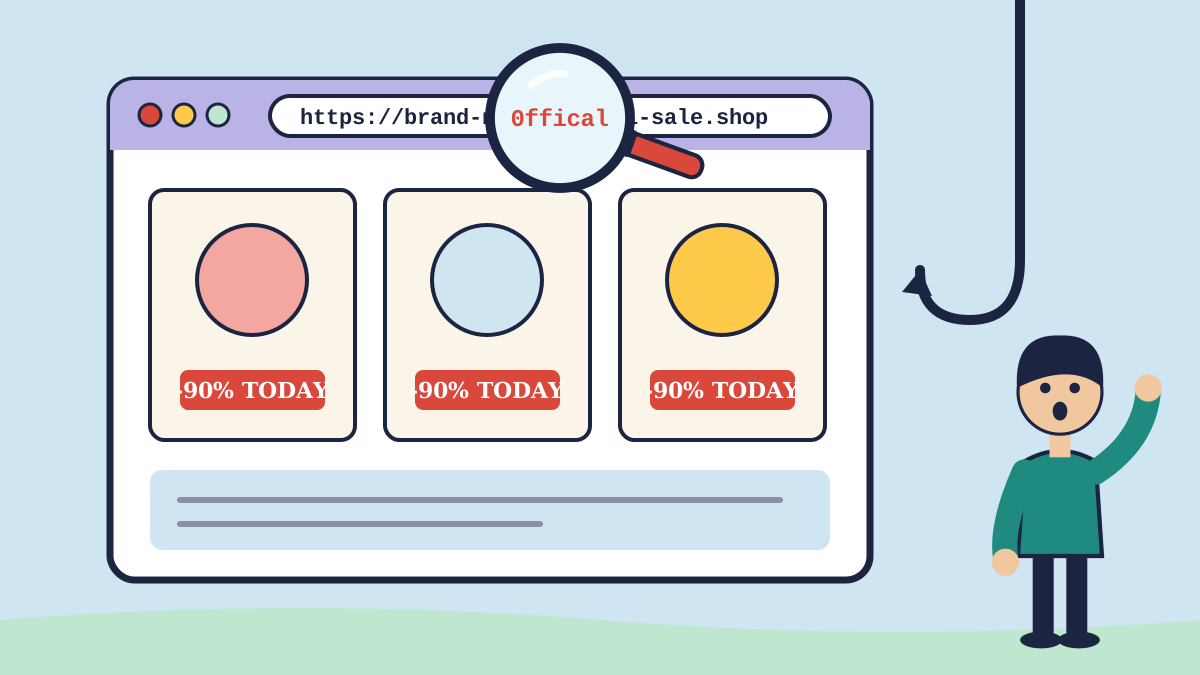
You have found exactly what you wanted, at a price that seems a little too good, on a website you have never heard of — often via an ad in your social media feed. Maybe it is a small independent shop. Maybe it is a fake store set up to take card details and ship nothing, or a counterfeit. Professional-looking design proves nothing: templates are cheap, product photos can be copied, and a padlock icon only means the connection is encrypted, not that the business is honest. Work through these checks instead.
Read the web address carefully
Look at the full address in the browser bar, not the link text or the ad. Fake shops often imitate real brands with small changes: an extra word such as “official”, “outlet” or “sale”, swapped letters, a zero instead of an “o”, or an unusual ending. If you are expecting a well-known brand, type its address yourself or search for it, rather than following an ad, and compare.
Check how old the website is
Every domain name has a registration record. You can look up any domain for free on ICANN’s lookup tool (lookup.icann.org), which shows when it was created. Many personal details are now hidden for privacy, which is normal, but the creation date is usually visible. A shop claiming decades of history on a domain registered a few weeks ago is a serious warning sign. A new domain on its own is not proof of fraud — every real business starts somewhere — but it means you should rely on other evidence.
You can also check whether a site has been flagged for malware or phishing using Google’s Safe Browsing site status tool in its Transparency Report. A clean result does not mean a shop is legitimate; it only means it has not been flagged for those specific threats.
Look for a real business behind the site
- Contact details: a physical address, a phone number that is answered, and an email address on the shop’s own domain. A contact form alone is weak evidence.
- Legal name: the terms and conditions or footer should name the company that runs the shop. Look it up on the official business register (see our guide to researching a company).
- Return address: read the returns page. Some shops that appear local ship from, and require returns to, another country at your expense.
- Copied text: paste a sentence from the “About us” or returns page into a search engine in quotation marks. Identical text on dozens of unrelated shops suggests a template store.
Search for the shop outside its own website
Search the shop name together with words like “scam”, “reviews” or “complaints”, and look at independent review platforms and forums. Pay attention to recent posts about orders never arriving, wrong items being sent, or refunds being refused. Reviews embedded on the shop’s own pages can be edited or invented, so they count for little; our guide to spotting fake reviews explains what to look for.
Check whether the shop has a social media presence with real history — posts going back years, comments from customers — rather than an account created recently with lots of ads and no conversation.
Common fake-shop patterns
- Huge discounts on popular or sold-out items, often 70–90% off.
- “Closing down” or “retirement” sales from shops you have never heard of.
- Countdown timers and “only 2 left” messages on every product.
- Payment only by bank transfer, money-transfer app, cryptocurrency or gift card, or a card payment that “fails” and is replaced with a request for a transfer.
- Emails after purchase with tracking numbers that never update or belong to a different parcel.
Five-minute online shop check
- Web address typed or checked character by character.
- Domain creation date looked up and compared with the shop’s claims.
- Legal business name found and checked on a register.
- Physical and return addresses identified.
- Independent reviews or complaints searched outside the site.
- Card or protected payment option available at checkout.
Pay in a way you can undo
Even after these checks, protect yourself at checkout. Paying by credit card or through a payment service that offers buyer protection gives you a route to your money if the goods never arrive or are not as described. Bank transfers, money-transfer apps, gift cards and cryptocurrency usually do not. Our guide to the safest ways to pay compares the options.
Save screenshots of the product page, price and terms, and keep the order confirmation. If a problem arises, contact the shop in writing first, then your card issuer or payment provider if it is not resolved.
If you think you’ve been caught
Contact your bank or card issuer immediately, explain what happened and ask about a chargeback or dispute. If you entered card details on a site you now distrust, ask for the card to be cancelled and reissued. Change any password you reused on that site. Report the shop: in the US to the FTC at ReportFraud.ftc.gov and to the FBI’s Internet Crime Complaint Center; in the UK to Report Fraud (Action Fraud). If you found the shop through a social media ad, report the ad to the platform as well.
Frequently asked questions
Does a padlock in the address bar mean a site is safe?
No. It means the connection between you and the site is encrypted. Scam sites routinely have padlocks. It says nothing about who runs the site or whether they will deliver.
Is a new website always a scam?
No. New businesses have new websites. A young domain simply means you should look harder at other evidence, such as the business registration, contact details and payment options.
Are drop-shipping stores scams?
Not necessarily. Many legitimate shops ship directly from suppliers. The risk is long delivery times, variable quality and difficult returns, so read the shipping and returns pages carefully.
What should I do if the card payment fails and they ask for a bank transfer?
Stop. Switching you from a protected method to an unprotected one is a common scam tactic.
Related articles
Money & fine print
The safest ways to pay: which payments you can get back
Which payment methods let you recover money when a purchase goes wrong: credit cards, debit cards, payment apps, bank transfers, gift cards and crypto compared for the US and UK. Open the case file →
Reviews & records
How to spot fake reviews: the warning signs
The common warning signs of fake, paid-for and incentivised reviews, what the rules say about them in the US and UK, and what to do when you find them. Open the case file →
Reviews & records