
Home Articles Reviews & records
Reviews & records
How to read online reviews without being fooled
An average star rating is the least informative number on the page. Here is how to pull real evidence out of the reviews underneath it.
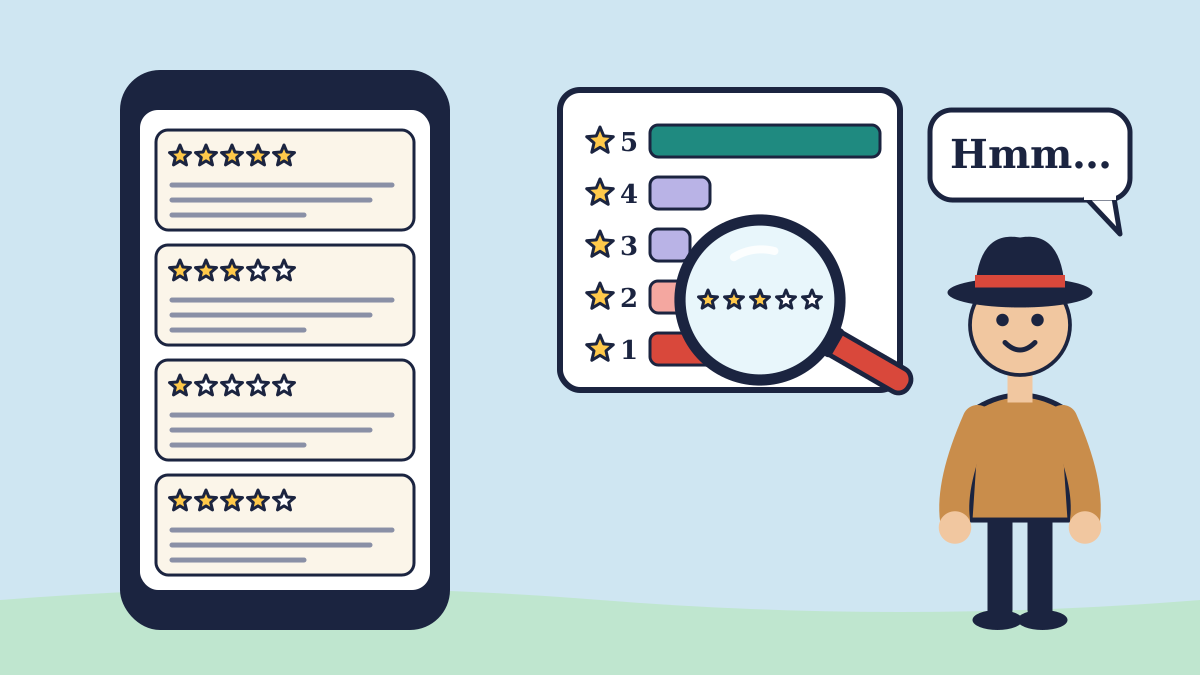
Reviews are one of the few places where you can hear from people who have already spent the money you are about to spend. That makes them valuable. It also makes them a target, and it means the headline number — 4.6 stars, say — hides almost everything you actually want to know. Two products can share the same average and have completely different stories underneath. This guide is a repeatable routine for reading reviews the way an investigator reads witness statements: looking for consistency, detail and motive.
Start with the shape, not the average
Most review platforms show a bar chart of how many reviews landed on each star value. Look at that before anything else. Genuine reviews for most products tend to cluster at five stars with a smaller bump at one star, because people who are delighted or furious are the most motivated to write. That lopsided “J” shape is normal. What deserves a closer look is a chart that is almost entirely five-star with a near-empty middle, or one that is split between five and one with nothing in between. The first can signal padding; the second can signal a product that works brilliantly for some people and fails badly for others — and you need to work out which group you would be in.
Then weigh the average against the count. A 4.9 from fourteen reviews tells you far less than a 4.4 from several thousand. Small samples swing wildly with a handful of friends-and-family reviews, and new listings are where manipulation is cheapest.
Read the middle: the three-star test
If you only have five minutes, spend them on the two- and three-star reviews. These reviewers usually bought the product, used it, found something good about it and something that disappointed them. They are the most likely to describe trade-offs in concrete terms: “great suction but the battery lasts twenty minutes on carpet”, “friendly crew but they left a week later than promised”. Write down every recurring complaint. If the same weakness appears in several independent middle-rated reviews, treat it as a known characteristic, not bad luck.
Then read a sample of one-star reviews and sort them into two piles: complaints about the product or service itself, and complaints about things outside its control (a courier losing a parcel, a buyer ordering the wrong size). Only the first pile tells you about what you are buying.
Check recency and what changed
Sort by newest. Products get redesigned, restaurants change chefs, and companies change ownership, customer-service teams and suppliers. A service with glowing reviews from three years ago and a run of recent complaints about missed appointments is telling you something about today. Look for dates where the tone shifts, and search for news around that time — a takeover, a new model year, a move to a different factory.
Be especially wary on large marketplaces of listings where reviews mention a different product altogether. Sellers sometimes group variations together or reuse an old listing, so praise for one item can end up attached to another. If the reviews talk about a colour, size or feature the listing does not have, the rating may not belong to the thing you are looking at.
Look at the reviewer, not just the review
Most platforms let you click through to a reviewer’s profile. A long history of varied reviews — some positive, some critical, across different kinds of purchases — is a good sign. A profile created last week with a handful of five-star reviews for unrelated products from the same seller is not. Neither is proof on its own; plenty of honest people only ever write one review. You are looking for patterns across many reviewers, not convicting any single one.
Notice disclosures too. Some reviews are labelled as written by people who received the product free or at a discount. That is allowed on many platforms when it is disclosed, but free-product reviewers tend to be kinder, so give those reviews less weight than paid-for ones.
| What you see | What it might mean | How to check |
|---|---|---|
| High average, very few reviews | Too small a sample to trust | Look for the same product or business on a second platform |
| Almost no two- to four-star reviews | Possible padding or review gating | Read the newest one-star reviews and the reviewer profiles |
| Same complaint in many middle reviews | A real, recurring weakness | Decide whether that weakness matters for how you will use it |
| Recent ratings much lower than older ones | Something changed | Sort by newest; search news for ownership or model changes |
| Reviews describe a different item | Merged or recycled listing | Check the review details against the listing’s exact model |
| Owner replies are defensive or identical | How you will be treated if it goes wrong | Read replies to the worst reviews, not the best |
Read how the business responds
For services especially, the owner’s replies are evidence. A business that answers a bad review with specifics — an apology, an explanation, an offer to fix it — is showing you its complaints process. A business that argues with customers, reveals their personal details, or pastes the same reply under every complaint is showing you something too. You will probably never need the complaints process, but if you do, this is what it looks like.
Triangulate outside the review platform
Reviews on the seller’s own website are curated by the seller. Reviews on a large marketplace are better but still shaped by that platform’s rules. Before a big purchase, look in at least one place the seller does not control: a complaints database, a consumer forum, a hobbyist community where owners discuss long-term reliability, or official records like recall lists and licensing boards. Our guides to researching a company and checking product recalls show where to look.
The ten-minute review routine
- Note the star distribution and the total number of reviews.
- Read five two- and three-star reviews and list repeated complaints.
- Sort by newest and read the most recent ten.
- Open three reviewer profiles, including one five-star reviewer.
- Read the business’s replies to its worst reviews.
- Check one independent source the seller does not control.
Match the reviews to your own use
Finally, filter everything through how you will actually use the thing. A hiking boot that people complain is “too stiff for city walking” may be exactly right for mountain trails. A contractor praised for speed may be the wrong choice if your priority is meticulous finishing. Reviews tell you what happened to other people in their situations. Your job is to find the reviewers whose situation looks most like yours, and pay the most attention to them.
Frequently asked questions
Is a 5.0 rating better than a 4.7?
Not necessarily. A perfect score is often based on a small number of reviews, and a spread of ratings with some criticism is typical of a genuine product. Look at the number of reviews and the content before comparing averages.
Should I ignore one-star reviews?
No, but sort them. Some are about delivery or user error, which tell you little. Others describe a genuine failure, and if several describe the same failure, take it seriously.
How many reviews should I read before buying?
There is no magic number, but reading around fifteen to twenty — weighted toward recent and middle-rated ones — usually reveals the main strengths and recurring problems.
Are reviews on the seller's own website trustworthy?
They can be genuine, but the seller controls which appear and how they are displayed. Treat them as a starting point and confirm with sources the seller does not control.
Related articles
Reviews & records
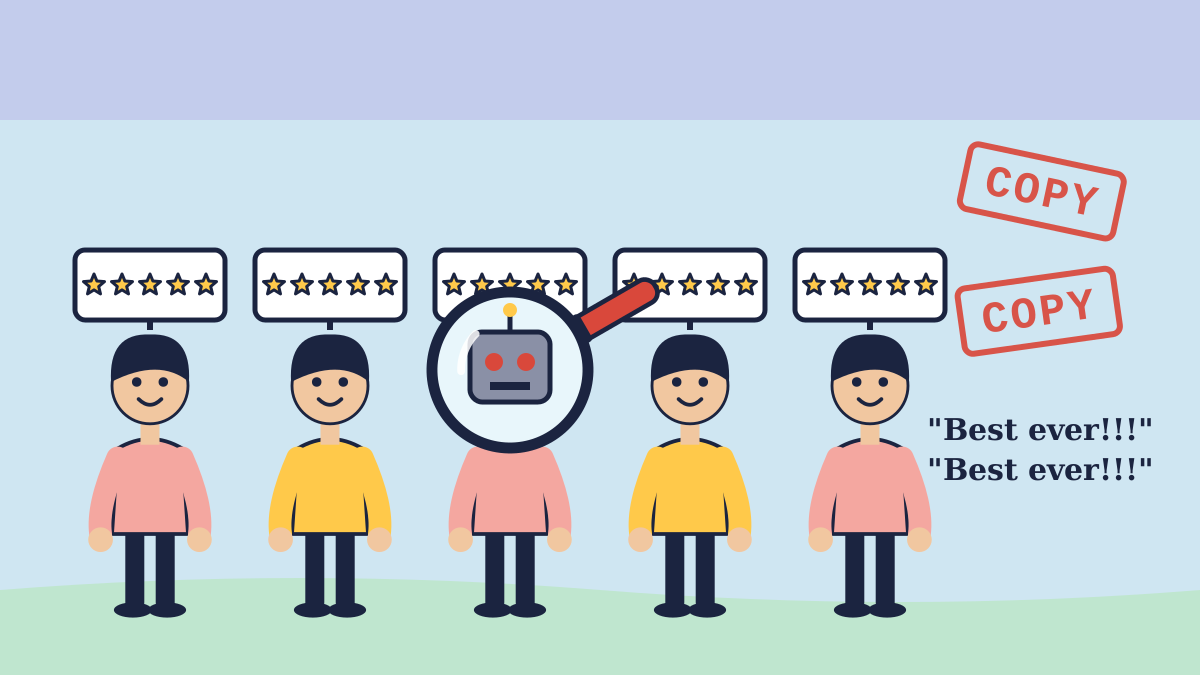
How to spot fake reviews: the warning signs
The common warning signs of fake, paid-for and incentivised reviews, what the rules say about them in the US and UK, and what to do when you find them. Open the case file →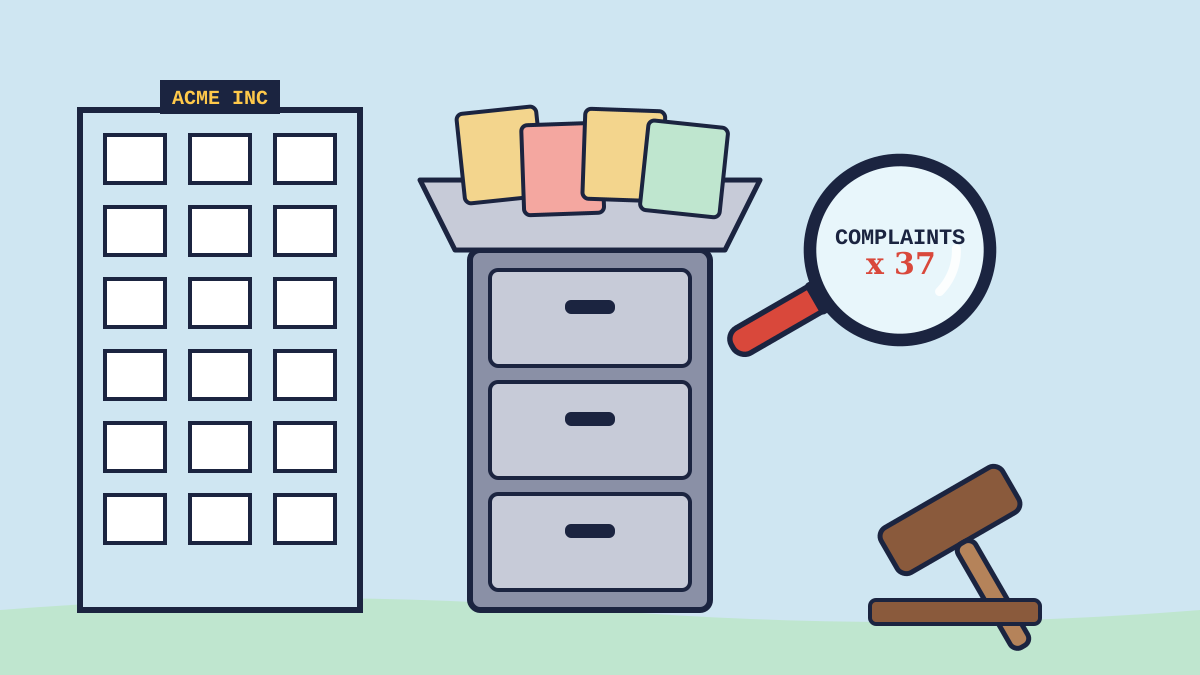
Reviews & records
How to research a company before you do business with it
Where to check a company's registration, age, address, complaints, court cases and regulatory status before you hand over money, in the US and UK. Open the case file →
Money & fine print